
Servo Motor — Working Principle (with Diagram & Interactive Demo)
A clear, unique explanation of how servo motors work — construction, closed-loop control, block diagram (SVG) and an interactive demo to visualise the feedback loop and shaft motion.
Introduction
Servo motors are precision actuators used where accurate angular position, velocity and torque control are required. They form the backbone of robotics, CNC machines, automated assembly, camera gimbals, and flight controls.
Construction — Major Parts
- Motor (DC / AC / BLDC): provides torque and rotation.
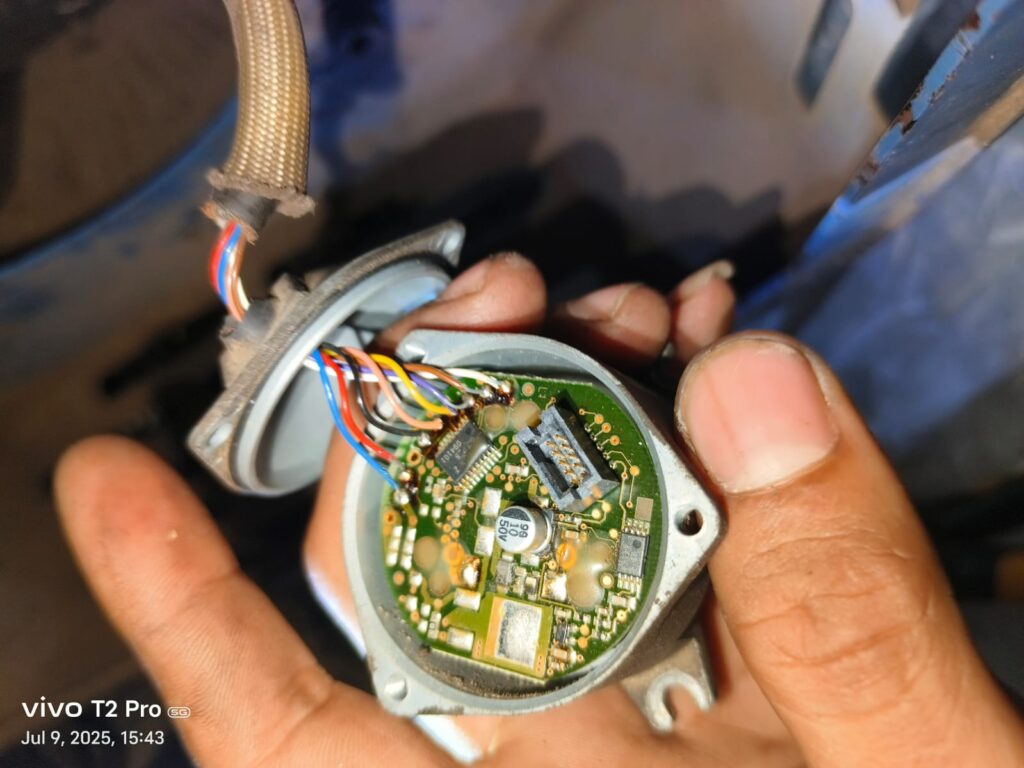
- Feedback device (Encoder or Resolver): continuously measures shaft position/speed.
- Driver / Amplifier: powers the motor based on control command.
- Controller (PID in many systems): generates command (reference) and processes feedback to compute correction.
- Gearbox (optional): increases torque and improves resolution.
Working Principle — Closed-Loop Control
The core idea is a closed-loop feedback system:
- Reference input: controller sends desired position (or speed).
- Compare: driver compares desired vs actual (from encoder) → error.
- Correct: controller / driver drives motor to reduce error.
- Feedback: encoder updates actual position; loop continues until error ≈ 0.
Diagram explanation
• Controller: generates desired position/speed (reference).
• Driver / Amplifier: converts control signal into motor current/voltage.
• Motor + Gearbox: produces shaft motion — gearbox increases torque and resolution.
• Encoder / Resolver: measures shaft position and sends feedback signal back to controller.
Red arrow is the feedback loop — it is the key for closed-loop control.
You can use the buttons above to animate the shaft for a quick visual of rotation.
Control Algorithms & Tuning
The controller often implements PID (Proportional–Integral–Derivative) or modern motion-control algorithms. Tuning PID gains (P, I, D) determines how aggressively the servo corrects errors — under-damped (overshoot) vs over-damped (slow).
Practical Tips
- Always match motor, driver and encoder specs for voltage/current & feedback protocol (TTL / differential / resolver).
- Enable soft limits and homing to avoid mechanical collisions.
- Use proper filtering and shielded cables for encoder lines to avoid noisy feedback.
FAQ
Q: Can I use a stepper as a servo?
A: Yes — by adding feedback (encoder) and closed-loop control you get many benefits: missed-step correction and higher reliability.
Conclusion
Servo motors use closed-loop feedback to provide precise position, speed and torque control. The combination of controller → driver → motor → encoder (feedback) is what makes them accurate and suitable for industrial automation and robotics.