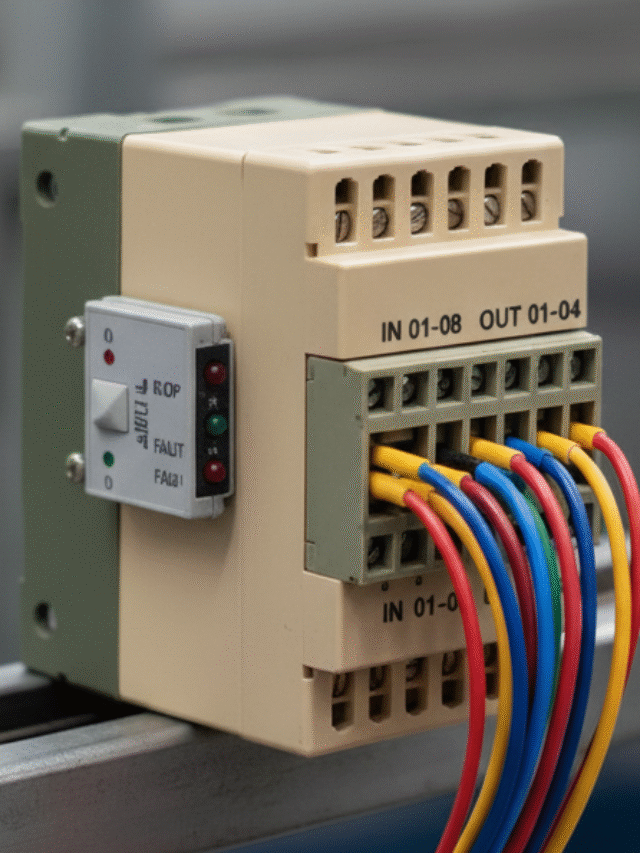

🔹 Part 1: Basic Electrical Questions
1. What is Ohm’s Law?
👉 Answer: Ohm’s Law states that current is directly proportional to voltage and inversely proportional to resistance.
Formula: V = I × R
2. What is difference between AC and DC?
👉 Answer:
- AC (Alternating Current): Direction changes periodically, easy for long-distance transmission.
- DC (Direct Current): Flows in one direction, used in batteries & electronics.
3. Why transformer does not work on DC?
👉 Answer: Transformer needs alternating flux. DC produces no changing flux → no induced EMF → transformer overheats.
4. What is difference between MCB and MCCB?
👉 Answer:
- MCB → up to 125A, for homes & small industries.
- MCCB → up to 1600A, for heavy industries.
5. What is Power Factor?
👉 Answer:
Power Factor = KW / KVA
- Shows efficiency of electrical system.
- Low PF → losses, penalty.
- High PF → efficient, reduced bill.
6. Why 3-phase power is preferred in industries?
👉 Answer: Provides smooth torque, requires less conductor size, supports heavy loads, cost-efficient.
7. What is difference between KW, KVA, and KVAR?
👉 Answer:
- KW = Real power (useful).
- KVA = Apparent power (total supplied).
- KVAR = Reactive power (magnetic field).
8. What is difference between Fuse and Circuit Breaker?
👉 Answer:
- Fuse melts & disconnects (one-time use).
- Circuit breaker can trip/reset multiple times.
9. What is Slip in Induction Motor?
👉 Answer: Slip = (Ns – Nr)/Ns × 100
- Ns = synchronous speed
- Nr = rotor speed
10. What is Star-Delta Starter?
👉 Answer:
- Used for induction motors to reduce starting current.
- Start in Star (low current), then switch to Delta (full load).
🔹 Part 2: Protection & Safety
11. What is ELCB/RCCB?
👉 Answer: Device that trips when earth leakage current flows → protects human life.
12. What is Isolator vs Circuit Breaker?
👉 Answer:
- Isolator = manual, no load operation.
- Circuit breaker = automatic, trips under fault.
13. What is Earthing?
👉 Answer: Connecting equipment to ground for safety → prevents electric shock.
14. Difference between Grounding & Neutral?
👉 Answer:
- Ground/Earth = safety connection to soil.
- Neutral = return path for current.
15. Why Capacitor is used in industries?
👉 Answer: To improve power factor by reducing reactive power.
16. What is Lightning Arrester?
👉 Answer: Protects system from lightning/surge voltages.
17. What is Buchholz Relay?
👉 Answer: Gas-actuated relay for transformer protection (detects gas due to internal faults).
18. What are common causes of motor failure?
👉 Answer: Overload, single phasing, overheating, bearing damage, insulation failure.
19. Difference between Overload and Short Circuit?
👉 Answer:
- Overload = long duration high current.
- Short circuit = sudden fault current.
20. Why industries install capacitor banks?
👉 Answer: To improve power factor, reduce penalties & save energy cost.
🔹 Part 3: Machines & Equipment
21. What is Synchronous Motor?
👉 Answer: Motor that runs at synchronous speed (no slip), used in power factor correction & precision work.
22. What is Induction Motor?
👉 Answer: Motor where rotor current is induced by stator → widely used in industries (fans, pumps, compressors).
23. What is difference between 1-phase and 3-phase motor?
👉 Answer:
- 1-phase = low power, needs capacitor to start.
- 3-phase = high power, self-starting.
24. Why do motors take high starting current?
👉 Answer: At standstill, back EMF = 0 → motor draws high inrush current (6–8× rated).
25. Why we use Star connection for transmission?
👉 Answer:
- Phase voltage is reduced.
- Neutral available for safety.
26. What is difference between Step-up and Step-down Transformer?
👉 Answer:
- Step-up = increases voltage, reduces current.
- Step-down = reduces voltage for utilization.
27. What is CT and PT?
👉 Answer:
- CT = Current Transformer (measures high current).
- PT = Potential Transformer (measures high voltage).
28. What is difference between Active, Reactive, and Apparent Power?
👉 Answer:
- Active (KW) = does work.
- Reactive (KVAR) = wasted in magnetism.
- Apparent (KVA) = total supplied.
29. What is difference between Synchronous Speed and Rotor Speed?
👉 Answer:
- Synchronous Speed = speed of rotating magnetic field (120f/P).
- Rotor Speed = actual motor speed (less due to slip).
30. What is Harmonic Distortion?
👉 Answer: Distortion in waveform due to non-linear loads (VFDs, rectifiers). Causes overheating & PF issues.
🔹 Part 4: Transmission & Distribution
31. What is Corona Effect in transmission lines?
👉 Answer: Corona is the ionization of air around conductors due to high voltage → causes power loss & humming sound.
32. What are HV, MV, and LV ranges?
👉 Answer:
- LV (Low Voltage): up to 1 kV
- MV (Medium Voltage): 1 kV – 33 kV
- HV (High Voltage): 33 kV – 220 kV
- EHV (Extra High Voltage): 220 kV – 765 kV
33. What is Sag in transmission line?
👉 Answer: Vertical distance between the conductor and straight line between supports. Controlled for safety & mechanical strength.
34. What is difference between Insulator and Conductor?
👉 Answer:
- Conductor = allows current (copper, aluminium).
- Insulator = blocks current (rubber, porcelain).
35. Why Aluminium is used in transmission lines instead of Copper?
👉 Answer:
- Light weight, cheaper, good conductivity, strong mechanical strength.
36. What is difference between Overhead Line and Underground Cable?
👉 Answer:
- Overhead: cheap, easy repair, but exposed to weather.
- Underground: costly, difficult to repair, but safe & aesthetic.
37. What is Ferranti Effect?
👉 Answer: In long transmission lines at light load, receiving end voltage becomes higher than sending end voltage due to capacitance effect.
38. What are different types of losses in transmission?
👉 Answer:
- Copper loss (I²R)
- Iron loss (Hysteresis + Eddy current)
- Corona loss
- Dielectric loss
39. What is Skin Effect?
👉 Answer: At high frequency, current flows near the conductor surface → effective resistance increases.
40. What is Proximity Effect?
👉 Answer: Current distribution in conductor affected by nearby conductors → increases resistance.
🔹 Part 5: Electrical Machines (Advanced)
41. Why DC is not used for transmission?
👉 Answer: High losses & no easy step-up/down with transformer (until HVDC tech introduced).
42. What is HVDC transmission?
👉 Answer: High Voltage Direct Current → efficient for long-distance, underwater cables, and interconnecting grids.
43. What is difference between Alternator and Generator?
👉 Answer:
- Alternator = produces AC.
- Generator = produces AC or DC.
44. What is difference between Auto-transformer and 2-winding transformer?
👉 Answer:
- Auto: single winding used as both primary & secondary (compact, cheap).
- 2-winding: separate primary & secondary (better isolation).
45. What is Eddy Current Loss?
👉 Answer: Circulating current induced in transformer/motor core → causes heating. Minimized by lamination.
46. Why Transformer Rating is in KVA not KW?
👉 Answer: Transformer handles both active (KW) & reactive (KVAR) power, so rated in KVA.
47. Why Induction Motor is called Asynchronous Motor?
👉 Answer: Rotor never runs at synchronous speed → always less (slip present).
48. Why Single-phase Induction Motor is not self-starting?
👉 Answer: Only produces pulsating field, not rotating. Capacitor used to create phase shift → self-start.
49. Why DC motors are rarely used now?
👉 Answer: Need frequent maintenance (commutator & brushes). AC motors & drives (VFDs) replaced them.
50. What is difference between VFD and Soft Starter?
👉 Answer:
- VFD (Variable Frequency Drive) = controls speed & torque by changing frequency.
- Soft Starter = reduces inrush current at motor start only.
🔹 Part 6: Power Systems & Control
51. What is difference between Relay and Contactor?
👉 Answer:
- Relay = low power control signal device.
- Contactor = high power switching device.
52. What is difference between Isolator and Switchgear?
👉 Answer:
- Isolator = manual, no fault protection.
- Switchgear = includes CB, relays, isolators for full protection.
53. What is difference between Current Transformer (CT) and Potential Transformer (PT)?
👉 Answer:
- CT reduces high current → measurable value.
- PT reduces high voltage → measurable value.
54. What is Load Shedding?
👉 Answer: Intentional power cut in some areas to balance demand & supply.
55. What is Blackout and Brownout?
👉 Answer:
- Blackout = complete power loss.
- Brownout = voltage drop (partial power reduction).
56. What is Synchronization of Alternators?
👉 Answer: Process of matching voltage, frequency, and phase before connecting two alternators in parallel.
57. What is AVR (Automatic Voltage Regulator)?
👉 Answer: Controls generator excitation → maintains constant output voltage.
58. What is SCADA?
👉 Answer: Supervisory Control and Data Acquisition system → monitors & controls electrical grid/industry remotely.
59. What is PLC?
👉 Answer: Programmable Logic Controller → used for automation in industries (machine sequence, safety interlocks).
60. What is Difference between Open-loop and Closed-loop Control?
👉 Answer:
- Open-loop: No feedback (e.g., simple heater).
- Closed-loop: Feedback present (e.g., temperature-controlled heater).
🔹 Part 7: Substation & Switchgear
61. What is a Substation?
👉 Answer: A substation is a part of the electrical system where voltage is stepped up or down using transformers and power is distributed safely.
62. What is Switchgear?
👉 Answer: A combination of circuit breakers, relays, isolators, fuses used for protection and control of power system.
63. What is SF6 Circuit Breaker?
👉 Answer: Circuit breaker that uses Sulphur Hexafluoride gas for arc quenching, highly reliable for HV systems.
64. What is Vacuum Circuit Breaker (VCB)?
👉 Answer: A CB where arc extinguishes in vacuum medium, used for medium voltage applications.
65. What is difference between Indoor and Outdoor Substation?
👉 Answer:
- Indoor: Equipment installed inside building (11kV, 33kV).
- Outdoor: Equipment installed in open yard (132kV and above).
66. What is GIS Substation?
👉 Answer: Gas Insulated Substation → uses SF6 gas, compact, reliable, suitable for metro cities.
67. What is Ring Main Unit (RMU)?
👉 Answer: A compact switchgear with CB + isolator used for 11kV distribution networks.
68. What is Difference between Single Line Diagram (SLD) and Wiring Diagram?
👉 Answer:
- SLD = simplified representation of electrical system.
- Wiring diagram = detailed connections of wires.
69. What is Transformer Oil Testing?
👉 Answer: Testing dielectric strength, acidity, and moisture in oil to ensure insulation & cooling properties.
70. What is Relay Coordination?
👉 Answer: Setting relays in sequence (primary & backup protection) so that nearest relay trips first.
🔹 Part 8: Testing & Measurement
71. What is Megger?
👉 Answer: An instrument used to measure insulation resistance of cables and machines.
72. What is Earth Resistance and how is it measured?
👉 Answer: Resistance between electrical installation and ground. Measured using Earth Tester (3-point/4-point method).
73. What is difference between Digital Multimeter and Clamp Meter?
👉 Answer:
- DMM = measures voltage, current, resistance directly.
- Clamp Meter = measures current without disconnecting wire.
74. What is Dielectric Strength?
👉 Answer: Maximum voltage an insulating material can withstand without breakdown.
75. What is High-Pot Test?
👉 Answer: High Voltage test done on cables/equipment to check insulation strength.
76. What is RCD Test?
👉 Answer: Residual Current Device test to check leakage current trip operation.
77. What is Earthing Resistance standard?
👉 Answer: Should be below 1 ohm for substations, below 5 ohm for general installations.
78. What is polarity test of transformer?
👉 Answer: Done to identify relative polarity of windings before parallel operation.
79. What is Continuity Test?
👉 Answer: A simple test to check whether current flows through a conductor or not.
80. What is Open Circuit & Short Circuit Test on Transformer?
👉 Answer:
- OC Test = finds core (iron) loss.
- SC Test = finds copper loss.
🔹 Part 9: Maintenance & Troubleshooting
81. What is Preventive Maintenance?
👉 Answer: Scheduled inspection & servicing to prevent faults before breakdown.
82. What is Predictive Maintenance?
👉 Answer: Uses sensors/data (vibration, temperature) to predict equipment failure in advance.
83. What is Breakdown Maintenance?
👉 Answer: Repairs done only after equipment failure.
84. What are common causes of Transformer failure?
👉 Answer: Overload, insulation breakdown, oil contamination, overheating.
85. What is Single Phasing?
👉 Answer: When one phase of 3-phase supply is lost → motor overheats, winding damage.
86. What is Phase Sequence?
👉 Answer: Order of phase rotation (R-Y-B). Wrong sequence → motor runs in reverse.
87. What is Motor Protection Relay (MPR)?
👉 Answer: Protects motor against overload, single phasing, earth fault, over/under voltage.
88. What is difference between Manual and Automatic Star-Delta Starter?
👉 Answer:
- Manual: switching done manually.
- Automatic: switching done by timer/contactors.
89. What is Cable Derating?
👉 Answer: Reducing cable current capacity when operating at high temperature or in bundle.
90. Why CT secondary should never be open?
👉 Answer: If CT secondary is open, high voltage develops → dangerous, may damage CT & operator.
🔹 Part 10: Latest Technology & Govt Exam Focus (2025)
91. What is Smart Grid?
👉 Answer: Modern grid using digital communication, IoT, automation for efficient power delivery.
92. What is Renewable Energy Integration?
👉 Answer: Connecting solar, wind, hydro with grid → requires inverters & smart control.
93. What is difference between On-grid and Off-grid Solar System?
👉 Answer:
- On-grid: connected to main supply, excess power exported.
- Off-grid: uses batteries, independent from grid.
94. What is Net Metering?
👉 Answer: A system where consumer exports excess solar power to grid & gets bill credit.
95. What is Energy Audit?
👉 Answer: Process of analyzing energy consumption & finding saving opportunities in industry.
96. What is Demand Factor?
👉 Answer: Ratio of maximum demand to connected load.
97. What is Diversity Factor?
👉 Answer: Ratio of sum of individual maximum demand to maximum demand of whole system.
98. What is Reliability in Power System?
👉 Answer: Ability of power system to supply continuous electricity without interruption.
99. What is AI & IoT role in Electrical Industry (2025)?
👉 Answer: Used for predictive maintenance, smart meters, energy optimization, automation.
100. What are the latest trends in Electrical Engineering (2025)?
👉 Answer:
- Smart Grids & Microgrids
- Electric Vehicles & Charging Stations
- HVDC Transmission
- Renewable Energy Storage
- Digital Substations
Nice information